

My first June after discovering sapphic literature was one of eager anticipation. I had loved sapphic novels from the moment I picked up “The Lady’s Guide to Celestial Mechanics” the year prior, and waited all year for Pride Month so that I could get new recommendations. Sure enough, they started rolling in! Scrolling through TikTok, I saw video after video advertising “queer book recs.” But what I saw was disappointing at best. In these videos, the word “queer” seemed to be synonymous with male-loving-male (MLM); every single video was full of nothing but MLM novel recommendations.
Literature

Beauty, Past Blood and Shame, in “On Earth We’re Briefly Gorgeous”
“On Earth We’re Briefly Gorgeous” by Ocean Vuong (he/him) unearths the life and history of a young gay Vietnamese-American man, Little Dog. Though the novel moves between his grandmother’s and mother’s lives in Vietnam to his life in the U.S., it isn’t only an “immigrant story” or a “gay story.” Rather, it encompasses his queerness, race, class, family, and humanity.

Queering Masculinity in “Stone Butch Blues”
Leslie Feinberg’s historical novel “Stone Butch Blues” voices the experiences of many butch and transmasculine individuals. In a transformative exploration of queer recognition and the way it damns and redeems us, the novel unearths critical queer history and underlines the importance of intersectional solidarity. Courage, loneliness, and understanding echo through the story of the butch protagonist, Jess Goldberg.

Identities Intertwined: A Review of “lead me to the lilies” at Chinese American Culture Night 2023
On May 6, 2023, UCLA’s Association of Chinese Americans hosted its 34th annual Chinese American Culture Night. The three-hour production featured performances by several Chinese cultural clubs and its main show, “lead me to the lilies.” As we celebrate Asian American and Pacific Islander Heritage Month throughout the month of May and anticipate Pride Month in June, “lead me to the lilies” beautifully portrays certain nuances of the queer, second-generation Asian American experience.

Best of 2022: Staff Picks for Queer Books
Enjoy our staff’s recommendations for queer books released in 2022!

“Filthy Animals”: An Exploration of Queer Sexuality and Masculinity
I recently read “Filthy Animals” by Brandon Taylor, which was released last year in 2021. I’d been looking to read more explicitly queer novels, ones that explored themes outside traditional YA themes. “Filthy Animals” is an exploration of queer sexuality and masculinity, a book that seems to understand the contradictions between all levels of queer identity. It is a book that aims to explore generational trauma, the past haunting its characters like an ambivalent ghost where the characters crave an intimacy they haven’t before.
The Yassification of Shirley Jackson: A Queer Reading of The Haunting of Hill House
The queer horror genre has taken a lot of twists and turns to reach where it is today. First and foremost, it began with misrepresentation. With examples like the predatory lesbian figure in “Daughter of Dracula” or the blatant demonization…

Cemetery Boys: A Whimsical Celebration of Queer Latinidad
Illustrated by Christopher Ikonomou (Xe/He) “Cemetery Boys” is the tale of Yadriel, a trans Brujo trying to prove himself to his family who is too stuck in their ways to accept him as a Brujo. A few days before Dia…
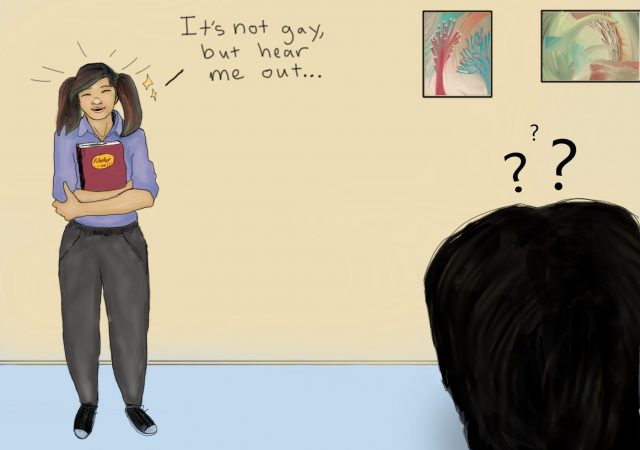
Books That Aren’t Gay, but We Love ‘Em Anyway
Graphic by Ria Kotak 1) “The Illuminae Files” by Jay Kristoff and Amie Kaufman “The Illuminae Files” is a science fiction trilogy co-written by Jay Kristoff and Amie Kaufman and illustrated by Marie Lu. It is set in the 26th…
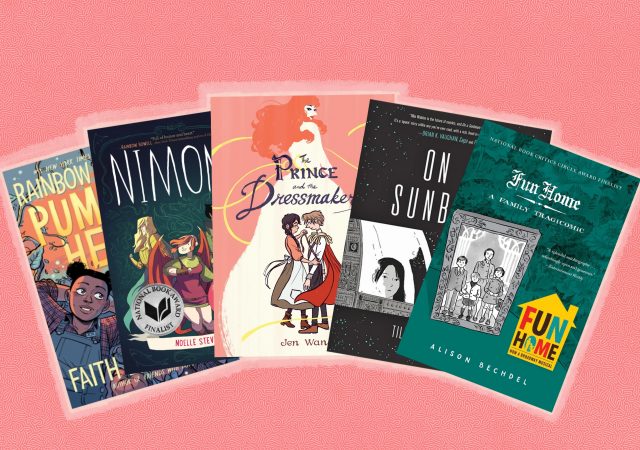
Five EnGAYging Graphic Novels
Image designed by Martha Cabot Over the past year, I’ve found myself gravitating toward graphic novels whenever I have time for spare reading. Partially, this is because they are usually much quicker reads than text-heavy novels. It also helps that…